
Imagine transforming your physique with exercises that require nothing more than the weight of your body and a dose of determination. This isn’t just a dream; it’s the reality of calisthenics push exercises. Known for forging impressive upper body calisthenics strength, these movements allow you to build muscle and increase power using the simplicity and resistance of your own form. Significantly, these exercises not only sculpt your body but also enhance your functional fitness, giving you the agility and endurance for the push-and-pull of daily life.
As you embark on this journey towards mastering bodyweight strength training, you’ll discover an exercise blueprint that’s as old as gymnastics itself, yet astoundingly effective in our modern fitness landscape. Whether you’re in the comfort of your home or amidst the expanse of a sunny park, calisthenics push exercises will challenge you to push a little harder and reach a little higher.
Key Takeaways
- Utilize your own body weight to master the art of calisthenics push exercises.
- Develop an upper body that not only looks strong but actually embodies strength and endurance.
- Embrace the efficiency of bodyweight strength training for a versatile workout anywhere, anytime.
- Learn powerful upper body routines that enhance both muscular and functional capabilities.
- Achieve a balanced and sustainable fitness regimen by including push exercises in your routine.
The Fundamentals of Calisthenics Push Exercises
Embark on a journey to master bodyweight burnout and elevate your strength with the essentials of calisthenics push exercises. Focus on your form, understand the mechanics, and you’ll master push-up variations and advanced calisthenics workouts that will reshape your fitness mindset.
Understanding Push Exercise Mechanics
Moving beyond the simplicity of traditional calisthenics, push exercises add an extra layer to your workout routine. These movements begin with an eccentric phase—your muscles lengthening under tension—before powerfully contracting to push resistance away from your body. Whether that resistance is a set of barbells or the more commonly used weight of your own body, the fundamental mechanics remain the same.
Essential Muscle Groups for Push Movements
Central to effective push exercises are key muscle groups that drive the movement. The chest muscles (pectoralis major and minor) are your powerhouses for pushing, carrying out a range of functions including adduction, medial rotation, and horizontal extension of the arms. Of equal importance is the anterior deltoid, which assists with shoulder flexion and horizontal abduction to create a complete upper body workout. Lastly, the triceps brachii contribute to the force exerted with each elbow extension, completing the trio of primary muscles activated during push exercises.
Push vs. Pull: A Balanced Approach to Upper Body Training
To achieve a well-rounded fitness profile, push exercises should be balanced with their counterpart: pull exercises. While push movements focus on ejecting force outward, pull exercises engage in drawing resistance toward your body—harnessing your biceps and back muscles. This yin and yang of fitness will ensure that you not only build strength evenly but also pave the way for dynamic bodyweight burnout sessions that further challenge your muscular endurance.
Whether you’re a seasoned athlete looking to enhance your advanced calisthenics workouts or a fitness enthusiast honing their push-up variations, integrating both push and pull movements is crucial to prevent injuries and promote muscle symmetry. Not to mention, it’s a perfect strategy for those seeking that enviable, sculpted physique.
| Exercise | Primary Muscles Worked | Key Benefits |
|---|---|---|
| Push-Ups | Chest, Shoulders, Triceps | Strengthens upper body, enhances core stability |
| Overhead Press | Anterior Deltoids, Triceps | Improves shoulder strength and mobility |
| Tricep Dips | Triceps | Isolates triceps for targeted strengthening |
Maximizing Bodyweight Burnout: An Overview
As you begin your journey into the realm of calisthenics, you’ll soon discover the power and simplicity of calisthenics push exercises. These exercises, crucial to a calisthenics routine for beginners, harness your inherent strength by transforming your body into the ultimate workout machine. With each press and dip, you’ll be building a formidable foundation of bodyweight strength training that’s as effective as it is economical.
Imagine a workout regimen that fits seamlessly into your life; no weights, no gym membership, just you and gravity, working in concert to carve out the fitness results you desire. That’s the essence of a bodyweight burnout – an intense session where you push your muscles to the brink, not by lifting heavy weights, but by manipulating your body through a variety of targeted movements designed for maximum impact.
The key to effectively practising these calisthenics push exercises lies in the balance of your regimen. Incorporating a push-pull training split encourages symmetry in your workout, ensuring each muscle group receives equal attention, promoting a harmonious physique, and reducing the risk of overtraining or injury.
Let’s dive into the sheer efficiency this form of exercise offers. The typical excuses of not having enough time or not owning the right equipment vanish. Whether you’re on the move or in the smallest of spaces, you can engage in a comprehensive workout that challenges your muscles at the highest level. These routines shine in their ability to be concise, yet potent, giving you the freedom to train more often and recover more quickly.
Your commitment to this practice will have you executing movements from the classic push-up to the progressive planche with a level of precision and power, perhaps you once thought unattainable. Every session adds a layer of strength, each repetition a brushstroke turning your body into a masterpiece of muscle and might.
So, whether you’re just stepping onto the fitness stage or seeking to spice up your established routine, calisthenics push exercises offer the perfect blend of challenge and accessibility. Embrace the burn, thrive on the progression, and watch as your body responds with gains in muscle strength, endurance, and an empowered sense of capability.
Integrating Advanced Calisthenics Workouts into Your Routine
As you delve into the realm of advanced calisthenics workouts, you’re not just stepping into a regular training program; you’re entering a discipline that will redefine the limits of your body’s capabilities. These-high intensity routines demand more than basic fitness—they challenge you to execute explosive push exercises with precision and control. It’s about transforming your body into a formidable force that can carry out upper body calisthenics with unparalleled power and grace.
To integrate advanced calisthenics into your fitness regimen, it’s essential to first solidify your mastery over the basics. This progression from foundational exercises to more intricate maneuvers ensures that you enhance your strength and muscle conditioning systematically. To make this integration seamless, let’s explore a methodical approach to advancing your calisthenics practice.
- Assess your current strength and proficiency in basic calisthenics moves.
- Gradually incorporate more challenging variations of these moves into your workouts.
- Frequently practice explosive push exercises to build power and agility.
- Be consistent with your training, allowing for adequate recovery between intense sessions.
Advanced calisthenics goes beyond enhancing your physique; it strengthens the mind-body connection, teaching you to push through barriers with focused intent. Embrace the burn, harness your inner strength, and witness the transformation as you perform advanced movements that once seemed beyond reach.
To better understand how to progress through your calisthenics journey, consider the following table, which outlines key exercises to incorporate over time:
| Progression Stage | Exercise | Primary Focus |
|---|---|---|
| Beginner | Standard Push-Ups | Building foundational strength |
| Intermediate | Archer Push-Ups | Developing unilateral strength & balance |
| Advanced | Explosive Clapping Push-Ups | Enhancing power & muscle activation |
| Expert | Planche Push-Ups | Mastering body control & stability |
Remember, advancing in calisthenics is not solely about increasing the difficulty of your workouts; it’s also about refining your technique to perform each movement with optimal efficiency. With persistence and dedication, you’ll find yourself executing even the most complex of routines with ease. The transformation awaits you—both in muscle definition and in the sheer power you bring to each move. So why wait? Start integrating those advanced calisthenics workouts today and become the strongest version of yourself.
Exploring Push-Up Variations for Increased Strength
When it comes to calisthenics push exercises, push-ups stand as the quintessential move that has stood the test of time. They’re the bread and butter of bodyweight strength training, revered for their simplicity and the deep impact they have on muscle development. Let’s delve into the world of push-up variations, where small modifications can create a world of difference in maximizing your strength gains.

Standard Push-Ups and Their Impact on Muscle Development
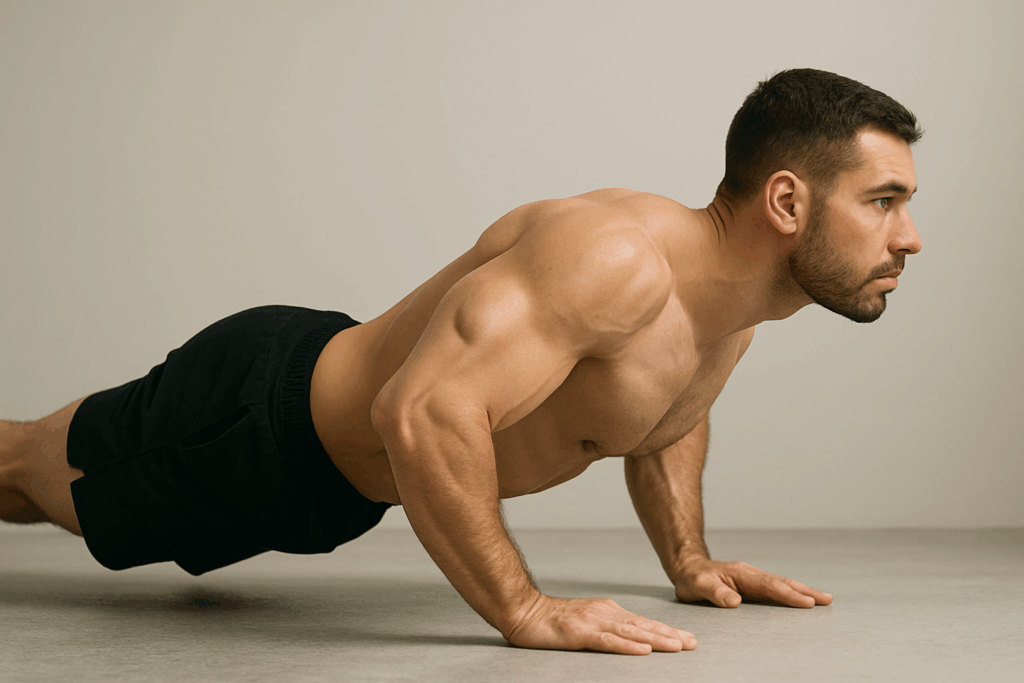
There’s no denying the effectiveness of standard push-ups in a solid calisthenics routine. Engaging a host of upper body muscles, including your pectorals, deltoids, and triceps, standard push-ups lay the groundwork for a solid fitness foundation. The beauty of these exercises lies in their ability to simultaneously target multiple muscle groups, providing a harmonious synergy that astutely enhances overall muscle development.
Hand Placement and Body Positioning to Enhance Intensity
Crafting the perfect push-up variation is a matter of adjusting hand placement and body positioning. These subtle yet significant shifts can magnify the intensity of your workout, challenging your muscles in new and dynamic ways. Broaden your grip to place more emphasis on your chest, or bring your hands closer for a tricep-intensive session. Why not elevate your feet to add gravity to the mix? Or incorporate plyometric elements like a clap to really fire up those muscle fibers. Each variation not only spikes up the challenge but also ensures a varied calisthenics push experience that keeps both your muscles and mind engaged.
| Variation | Muscle Focus | Intensity Level |
|---|---|---|
| Wide Grip Push-Up | Chest, Shoulders | Moderate |
| Diamond Push-Up | Triceps, Inner Chest | High |
| Decline Push-Up | Upper Chest, Shoulders | High |
| Plyometric Push-Up | Chest, Shoulders, Core | Very High |
Remember, as you expand your repertoire with these push-up variations, maintain the core principles of bodyweight strength training: proper form, consistent engagement, and progressive overload. By doing so, you’ll ensure a steady path toward increasing strength and muscle definition. Now, get ready to push the boundaries of your capabilities and tap into the untapped potential of your physique.
Principles of Bodyweight Strength Training: Techniques and Execution
If you’re aiming to harness the power of bodyweight strength training to its full potential, understanding the core principles is essential. These foundational techniques form the bedrock of advanced calisthenics workouts and can dramatically boost your upper body calisthenics prowess.
Low Reps and Heavy Loads for Peak Strength
Embarking on a strength-centric routine? Anchoring your workouts in low repetitions with heavy loads (or more arduous bodyweight progressions) is a tried-and-true method for peak strength. By squeezing out fewer reps at higher intensities, you’re not just challenging your muscles; you’re compelling them to become more resilient and robust.
Meticulously structured, such high-intensity workouts stimulate your muscle fibers deeply, setting the stage for significant strength gains. This vital strategy is at the heart of any disciplined bodyweight strength training regimen.
Important Considerations for Set Volume and Rest Durations
While pushing your boundaries, it’s crucial to factor in the volume of sets completed and the duration of rest intervals between them. These rests, lasting at least three minutes, are not mere pauses but valuable time for muscle and nervous system recovery. They allow the replenishment of vital energy stores which are critical for maintaining the intensity of your bodyweight strength training.
A measured approach to your sets solidifies your efforts, balancing the rigors of exertion with the wisdom of recovery—an approach vital for sustainable progress and for averting the pitfalls of overtraining.
Progressive Overload: The Pathway to Strength Gains
The journey to amplified strength and proficiency in advanced calisthenics workouts is paved with the principle of progressive overload. As you develop, so should the complexity and difficulty of your exercises. This means consistently enhancing your routine: adding more reps, refining technique, or exploring more challenging variations. These incremental adjustments keep your muscles guessing and growing—propelling you onward in your journey of physical excellence.
Remember, the path to mastery in upper body calisthenics is riddled with challenges, but it is also one of remarkable growth. By sticking to these foundational principles and persistently pushing your potential, you’ll witness the profound transformation in your strength and physique—making every drop of sweat along the way utterly worth it.
Calisthenics Push Exercise Routine for Beginners
Are you ready to embark on your fitness journey with a calisthenics routine for beginners? It all starts with a strong foundation, and that means embracing the basics with simple push exercises. These foundational movements will not only kickstart your path to fitness but also ensure your progression is built on a bedrock of correct form and technique.
Starting with the Basics: Simple Push Exercises
Simple push exercises, such as the classic push-up, are your stepping stones to a powerful and resilient upper body. As a beginner, it’s crucial to start with movements that are manageable yet effective. Engage in exercises that set the stage for growth and help you understand the importance of proper body mechanics.
Building a Solid Foundation with Proper Technique
As you delve into these simple push exercises, remember that technique trumps everything. Incorrect form not only hampers your gains but can also lead to long-term injuries. Make sure you’re practicing each movement with control and precision, enabling you to perform at your best and prepare for more challenging routines as you progress.
Frequency and Consistency in Beginner Routines
When it comes to establishing a calisthenics routine for beginners, consistency is key. Your commitment to regular practice will not only enhance your strength but also build the muscle memory required for more advanced exercises. Start with a few sessions a week, and as you grow stronger and more confident, you can gradually increase the intensity of your bodyweight burnout sessions.
Explosive Push Exercises: Taking Your Calisthenics to the Next Level
Ready to skyrocket your bodyweight strength training and add some dynamic motion to your regimen? Explosive push exercises are the catalyst you’ve been searching for. By injecting these high-velocity movements into your routine, you’re not only increasing muscular endurance but also engaging in an advanced calisthenics workout that challenges your body like never before.
Imagine propelling your fitness forward with exercises that combine raw strength with the breathtaking speed of execution. These advanced calisthenics workouts revolve around fast, powerful movements, catapulting your routine into a new echelon of energy and effectiveness.
Whether it’s through the ground-shaking force of plyometric push-ups or the soaring motion of star jumps, these workouts demand not just physical prowess, but also an unwavering commitment to perfection in form. The result? A training experience that not only enhances power but also drastically increases both muscular and cardiovascular endurance.
With these explosive movements, you’ll witness a notable progression in your calisthenics skills, translating to significant advancements in overall fitness and strength. Let’s break down how you can incorporate explosive push exercises into your regimen.
- Start with a solid base. Ensure that you’ve mastered the fundamental push movements before venturing into their explosive counterparts.
- Graduate to power. Begin by incorporating low-impact explosive exercises and gradually work your way up to more challenging variants.
- Focus on form over flair. Execute each movement with precision to maximize effectiveness and minimize injury.
- Mix it up. Introduce a variety of explosive push exercises to constantly challenge your muscles in new ways.
- Rest and recovery. Give your muscles time to recuperate after these intense workouts.
Embrace these advanced techniques, and you’ll not only fortify your bodyweight strength training but also boost your agility and athletic performance. So push past the ordinary and explode into your next level of calisthenics today!
Gathering the Benefits of Calisthenics Push Workouts
Embracing the variety of calisthenics push exercises is akin to unlocking a treasure trove of physical glory. It lays the groundwork for robust muscle definition and imbues your body with a power that is both visible and practical. The beauty resides in the adaptability of this approach, allowing you to harvest strength gains that can only come from a regimented routine swimming in diversity—be it the classic push-up or its many challenging iterations.
Creating a Sustainable Practice for Long-term Strength
Conjuring a sustainable practice that leads to long-term strength is not simply about endurance; it is about commitment to a routine tailored to your goals and abilities. As you delve further into the world of upper body calisthenics, trust in the process and recognize that progress is a product of discipline and smart execution. Intertwine both foundational and complex moves within your workouts, and you will not only persist—you will thrive, making every push-up a step closer to your pinnacle of strength.
Your journey through calisthenics is much more than a series of movements; it’s a transformative engagement with your body’s own resistance. As you persist and perfect your form, rest assured that the gauntlets you throw down today will be the milestones you surpass tomorrow. Set forth with these practices and embrace the ageless ethos of calisthenics push exercises to carve a stronger, more agile version of you.
Conclusion
As we encapsulate our exploration into the dynamic world of calisthenics push workouts, it’s clear why these practices hold such a revered place in sustainable strength training. By consistently engaging in upper body calisthenics, you not only fortify the muscles that outline your physique but also embrace a level of functional fitness that propels your day-to-day capabilities.
FAQ
What are calisthenics push exercises and how do they build strength?
Calisthenics push exercises are bodyweight resistance training movements that focus on the act of pushing to work the upper body. These movements, such as push-ups, target your chest, shoulders, triceps, and even core, contributing to the development of upper body strength.
What muscle groups are essential for effective push movements?
The primary muscle groups involved in push movements include the pectoralis major and minor (chest muscles), the anterior deltoids (front shoulder), and the triceps brachii (back of your upper arm). These muscles work cooperatively to perform the pushing action.
Why should I balance push exercises with pull exercises in my workout routine?
To prevent muscular imbalances and reduce the risk of injury, it’s important to train both the pushing and pulling muscle groups. This approach ensures a well-rounded training regimen that encourages symmetry and functional strength in the upper body.
What does bodyweight burnout mean in calisthenics training?
Bodyweight burnout refers to performing bodyweight exercises to the point of muscle fatigue, pushing the endurance of your muscles. This method can enhance endurance, muscle growth, and stamina using exercises like push-ups and dips.
How can I integrate advanced calisthenics workouts into my routine?
Begin with foundational exercises to build your strength and form. As you progress, gradually introduce more challenging variations and advanced movements, like explosive push-ups or handstand push-ups, to push your limits and further develop muscular strength.
What are the benefits of exploring push-up variations?
Experimenting with different push-up variations can engage the muscles in new ways, prevent workout monotony, and break through strength plateaus. Variations adjust the difficulty and focus on different upper body muscle groups.
How do low reps with heavy loads contribute to peak strength?
In calisthenics, “heavy loads” equate to more challenging progressions. Performing low reps with maximum effort on these progressions creates the resistance needed to stimulate muscle growth and strength gains effectively.
Why is rest important between sets in calisthenics?
Adequate rest between sets is crucial for recovery, allowing your muscles to replenish their energy stores and repair. Rest helps prevent fatigue and supports sustained energy and strength during your workouts.
What is progressive overload and how does it help in building strength?
Progressive overload is the process of gradually increasing the intensity of your workouts over time. In calisthenics, this can mean increasing reps, adding more challenging variations, or reducing rest time to continuously improve and gain strength.
How should beginners approach calisthenics push exercises?
Beginners should start with basic exercises like standard push-ups and focus on proper technique. Regular practice, combined with a gradual increase in intensity and complexity, will ensure a safe and effective foundation is built for more advanced exercises.
What are explosive push exercises, and why include them in my calisthenics routine?
Explosive push exercises are dynamic movements that combine strength and speed, such as clap push-ups. They help develop power, improve cardiovascular health, and can lead to greater overall strength and endurance.
How can I create a sustainable calisthenics push workout routine?
To create a sustainable routine, incorporate a range of exercises that address different muscle groups and movement patterns. Pay attention to your body’s cues, and ensure to include rest and recovery periods. Consistency, as well as gradual progression, will lead to long-term gains.


